If you are running a business in
2026, you’ve likely stared at a mounting to-do list and thought: “I need to
hire someone. Yesterday.”
But then the reality check hits.
Hiring a full-time employee (FTE) feels like a massive financial and structural
commitment. On the flip side, you hear the buzz about Virtual Assistants (VAs),
but you wonder if a remote partner can truly match the output of someone
sitting in an office chair down the hall.
The game has changed entirely. The
modern Virtual Assistant is no longer just someone handling calendar invites
from across the globe; they are an AI-augmented powerhouse.
Let’s break down the actual math,
the real tax implications, and how leveraging human-plus-AI synergy through
specialized partners can fundamentally scale your business.
The
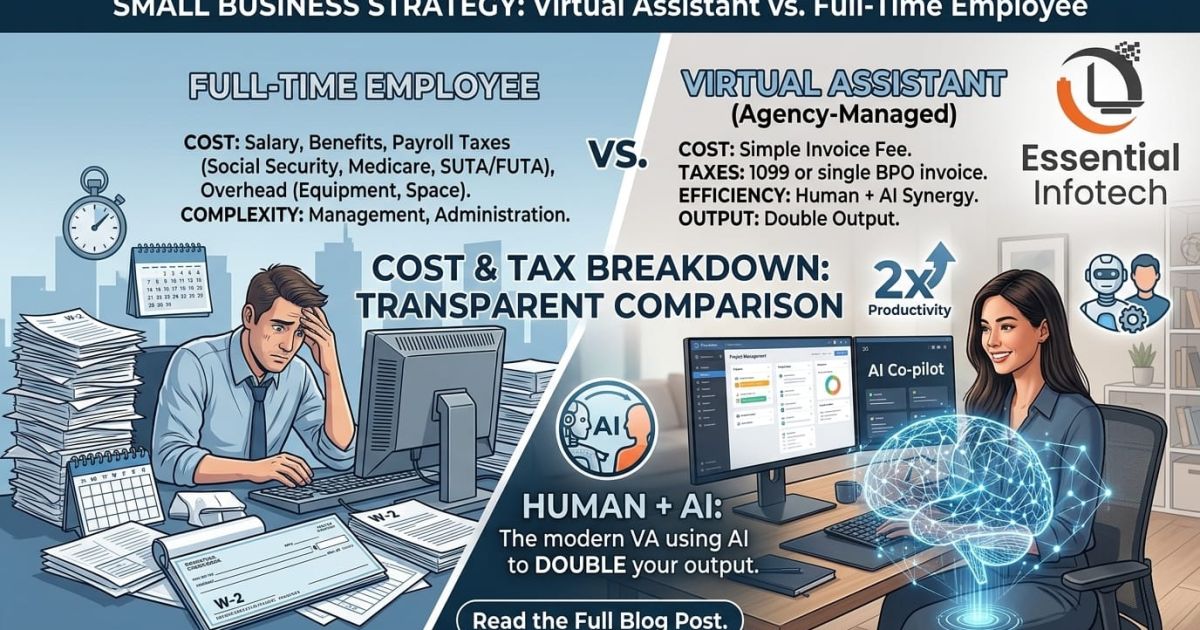
Cold, Hard Math: W-2 Employee vs. Virtual Assistant
When small business owners calculate
the cost of a full-time employee, they often look exclusively at the base
salary. That is a dangerous trap. The true cost of a traditional employee
includes what economists call "phantom overhead."
Let’s look at a realistic comparison
for an operations or administrative role.
|
Expense Category |
Full-Time Employee (W-2) |
Virtual Assistant Partner (Contract) |
|
Base Compensation |
$45,000 / year ($21.60/hr) |
$16,000 - $24,000 / year |
|
Payroll Taxes (FICA, FUTA, SUTA) |
~$3,800 (approx. 8.5%) |
$0 |
|
Benefits & Health Insurance |
~$5,000 - $7,000 |
$0 |
|
Equipment & Software Setup |
$2,000 (Laptop, desk, software seats) |
$0
(Provided by agency) |
|
Idle Time / Paid Leave |
~20-25% of paid hours are non-productive |
$0 (You
pay only for active output) |
|
Recruitment & Training |
~$1,500 - $3,000 |
$0
(Pre-vetted and trained) |
|
Total Real Cost |
$57,300+ / year |
$16,000 - $24,000 / year |
The
Tax Angle: Why Uncle Sam Favors the VA Model
When you hire a standard W-2
employee, you assume immediate tax liabilities. You are legally required to
match Social Security and Medicare taxes, pay into state unemployment funds,
and manage complex payroll compliance.
According to tax guidelines highlighted
on Talent Bridging, bringing
on a virtual assistant through an established business process outsourcing
(BPO) model completely bypasses the payroll tax infrastructure:
Human
+ AI: How 2026 VAs Double Their Output
There is a lingering myth that
outsourcing means sacrificing speed or quality. That mindset belongs in 2018.
Today, the most successful businesses scale because their remote talent
operates at a Human + AI equilibrium.
A modern VA does not let AI replace
their human judgment; they use it as an engine to automate repetitive work,
allowing them to focus on high-leverage execution.
[Repetitive
Task Data] ──> [AI Automated Heavy Lifting] ──> [Human VA Strategy &
Quality Check] ──> [Double the Output]
Here is exactly how this visual
workflow plays out across sectors:
1.
E-Commerce & Retail
2.
Real Estate & Property Management
3.
IT, SaaS, & Tech Houses
Enter
Essential Infotech BPO: The Growth Engine
This is exactly where Essential
Infotech bridges the gap for scaling businesses. As an ISO 9001 and
ISO 27001 certified global solutions provider, they don’t just hand you a
random remote worker and wish you luck. They provide a managed, secure, and
technologically advanced infrastructure designed to help small-to-medium
businesses develop products and services seamlessly.
Through their comprehensive BPO and Back-Office Services, Essential Infotech
supports critical, high-impact growth channels:
By offloading transactional,
process-driven workflows to a trusted offshore partner, you stop burning
premium capital on internal operational friction. Instead, you convert fixed
labor overhead into variable, highly efficient growth expenses.
Yes.
Unlike full-time W-2 employees where you must pay and match payroll taxes
(FICA, FUTA, SUTA), payments made to a Virtual Assistant or an agency like
Essential Infotech are classified as professional service fees or independent
contractor expenses. They are 100% tax-deductible under standard operating
costs, lowering your business's net taxable income without the headache of
complex payroll accounting.
Modern VAs use AI as an operational engine rather than
a complete replacement for human effort. They leverage AI for heavy-lifting
tasks—such as draft generation, data sorting, or initial lead
categorizations—and then apply human oversight, contextual editing, and brand
alignment. This "Human + AI" synergy allows them to double their
traditional output while ensuring high quality and zero errors.
While any business looking to reduce overhead can
benefit, high-volume and process-driven sectors see the fastest ROI. E-commerce companies utilize
VAs for product updates, supply chain management, and 24/7 customer support. Real Estate firms rely on them
for rapid CRM lead tracking and scheduling, while IT and Software houses leverage technical
back-office VAs to handle documentation and data maintenance.
Essential Infotech operates with rigorous global
security frameworks, holding both ISO 9001 (Quality Management) and ISO 27001 (Information Security
Management) certifications. This ensures that sensitive operational files,
financial records, client databases, and intellectual property are handled
under strict, enterprise-grade compliance and encryption standards.














We Are A Leading IT Company Experienced In Creative And Innovative Development And Design Solutions .

We are a leading IT company experienced in innovative development and design solutions. We have a unique, out-of-the-box approach to cope with custom clients' needs and demands. Success is essential to your business; so are we!
© 2023 All Rights Reserved by Essential-Infotech